
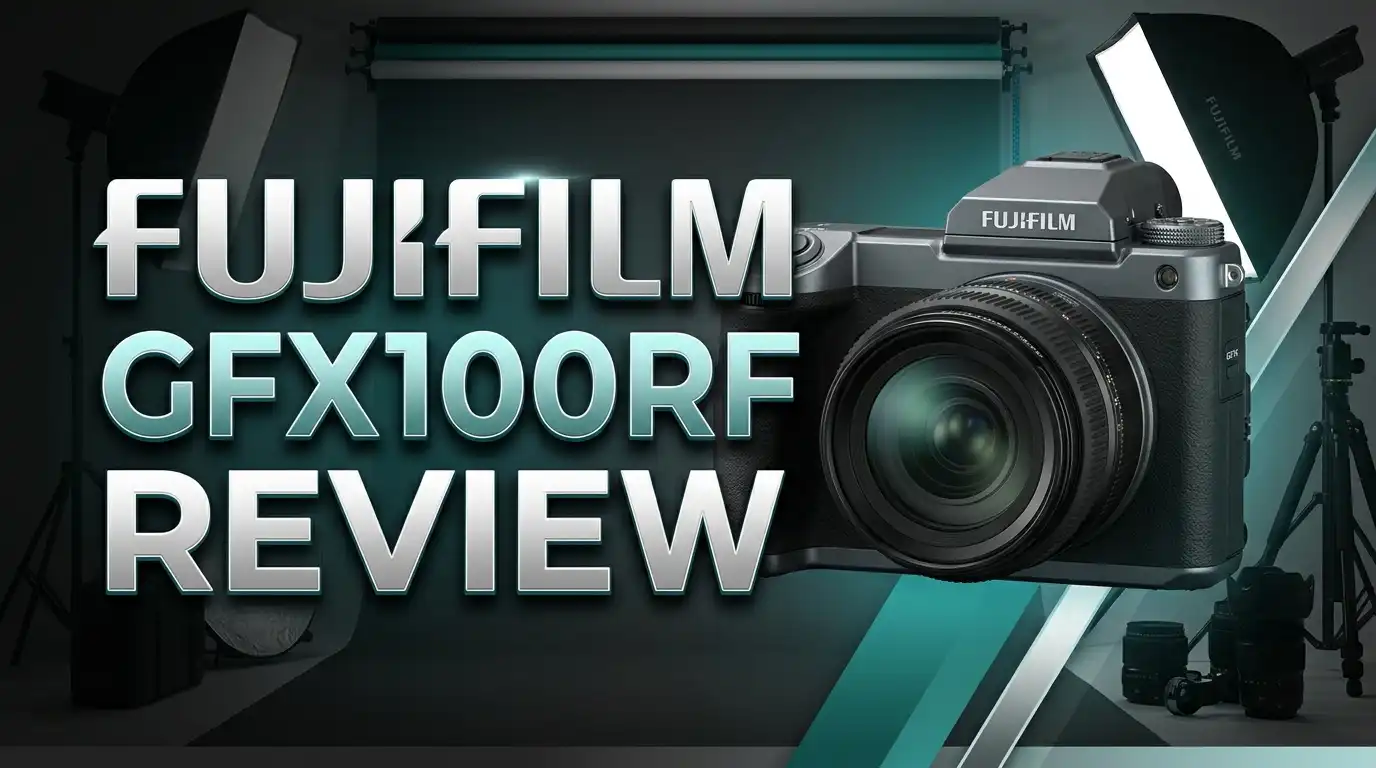
Fujifilm GFX100RF Review 2026: Worth $4,899?
Have you ever imagined carrying a 102 megapixel medium format camera in a bag small enough for daily travel? The Fujifilm GFX100RF makes that dream real.
This camera packs a massive 44x33mm sensor, a fixed 35mm f/4 lens (28mm equivalent), and Fujifilm’s best color science into a body that weighs just 735 grams. It is the smallest and lightest medium format camera ever made with a built in lens.
So is this camera still worth buying in 2026? This full review breaks down everything you need to know. By the end, you will have a clear picture of whether the GFX100RF fits your style and budget.
Key Takeaways
- 102MP medium format sensor delivers extraordinary resolution and detail. Files contain rich color information and wide dynamic range. Even cropped images hold impressive quality down to roughly 30MP at the 50mm equivalent setting.
- Compact and lightweight body at just 735g makes it the most portable medium format camera available. It measures 133.5 x 90.4 x 76.5mm and fits in most camera bags with ease.
- Fixed 35mm f/4 lens (28mm equivalent) performs well in good light with sharp center performance and a leaf shutter that syncs with flash up to 1/4000 second. The built in 4 stop ND filter adds creative flexibility.
- No IBIS and a slow f/4 aperture create challenges in low light. Handheld shooting below 1/25 second produces inconsistent results. Night photography requires higher ISOs or a tripod.
- Outstanding battery life rated at 820 shots (CIPA) means you can shoot for two full days on just two batteries. This far exceeds most mirrorless cameras on the market.
- Priced at $4,899, the GFX100RF sits below the GFX100S II ($4,999) and well below the Leica Q3 ($6,295). It offers medium format resolution at a relatively accessible price for this class of camera.
Fujifilm GFX100RF: Design and Build Quality

- Compact, portable rangefinder style design delivers classic camera handling
- New Aspect Ratio dial for instant access to a variety of compositional image formats

Last update on 2026-06-08 / Affiliate links / Images from Amazon Product Advertising API
The Fujifilm GFX100RF is a beautiful camera. It comes in two finishes: all black and black with silver. The top plate is machined from a single block of aluminum. Fujifilm says each unit spends over five hours on the production line, with four of those hours dedicated to grinding the top plate alone.
The camera looks like a scaled up version of the X100VI. From the top and sides, the two cameras appear almost identical. Only from the front does the GFX100RF reveal its taller body and the absence of the optical viewfinder cutout.
Build quality is premium. The body feels solid in hand. Weather sealing is available when you attach the included adapter ring and filter. The rangefinder style housing is elegant but functional.
The included square lens hood adds style but also adds bulk. Without the hood and adapter ring, the lens profile stays impressively thin. With both attached, the camera nearly doubles in depth from the front. Many users prefer to leave the hood off for everyday carry.
Fujifilm GFX100RF: Handling and Controls
The GFX100RF is packed with manual controls. Fujifilm has carried over the signature dual shutter speed and ISO dial from its X series rangefinders. You spin the dial to change shutter speed. Pull it up and twist to adjust ISO through a small window.
There is an exposure compensation dial, front and rear command wheels, an AEL button, and a customizable front plate lever. The lever detects both short flicks and long holds in two directions. That gives you access to up to four custom functions from a single control.
The aperture ring on the lens includes an automatic mode and textured nubs for easy adjustment. The Q button opens a customizable on screen panel. A joystick on the rear lets you move the focus point quickly.
One noted issue is the joystick sensitivity. Multiple reviewers found that the joystick sometimes fails to register inputs, requiring repeated presses. This is a consistent complaint across early production units.
Fujifilm GFX100RF: Image Quality and Resolution
The GFX100RF uses the same 102MP GFX CMOS II sensor found in the GFX100S II. This is a 44x33mm back side illuminated chip with a primary color filter. It produces images with stunning detail, color depth, and dynamic range.
In good light, this sensor delivers results that surpass every full frame and APS C camera on the market. Raw files capture noticeably more detail than the 61MP sensor in the Leica Q3 and far more than the 40MP chip in the X100VI. Dynamic range at base ISO 80 is excellent.
Color output is classic Fujifilm. The camera supports all 20 film simulations, including Provia, Velvia, Classic Neg, and Nostalgic Neg. Photographers who love Fujifilm’s color science will find everything they expect here.
File sizes are large. Raw files exceed 100MB each. JPEGs at full resolution range between 50MB and 70MB. A 128GB SD card fills up fast. Plan for extra storage.
Top 3 Alternatives for Fujifilm GFX100RF
1. Fujifilm X100VI — A smaller, lighter, and more affordable option with a 40MP APS C sensor, hybrid optical/electronic viewfinder, IBIS, and a 35mm equivalent f/2 lens. It costs $1,599 and is ideal for street and travel photography.

- 40.2MP X-Trans CMOS 5 HR Sensor
- Up to 6.0 stops In-Body Image Stabilization
Last update on 2026-06-08 / Affiliate links / Images from Amazon Product Advertising API
2. Leica Q3 — A full frame fixed lens compact with a 60MP sensor, 28mm f/1.7 Summilux lens, optical stabilization, and 8K video. It costs $6,295 and delivers exceptional low light performance.

- Leica Q3: A groundbreaking digital camera renowned for its innovative features and...
- Triple Resolution Sensor: Featuring a first-ever 60MP BSI CMOS sensor with Triple...
Last update on 2026-07-01 / Affiliate links / Images from Amazon Product Advertising API
3. Fujifilm GFX100S II — An interchangeable lens medium format body with the same 102MP sensor, IBIS, and access to the full GF lens lineup. It costs $4,999 (body only) and gives you more versatility for different focal lengths.

- FUJIFILM GFX100S II digital camera features a newly developed sensor and processor...
- Small, light, ergonomic body weighing 883g1 (1.95lbs) that is comparable in weight and...
Last update on 2026-06-08 / Affiliate links / Images from Amazon Product Advertising API
Fujifilm GFX100RF: Lens Performance
The built in Fujinon 35mm f/4 lens (28mm full frame equivalent) is sharp in the center and performs reasonably well into the corners. Light falloff is visible in Raw files at the edges, but Fujifilm’s JPEG engine corrects this effectively.
Chromatic aberration is well controlled. The lens handles flare decently, though the included adapter ring and hood help reduce stray light. Minimum focus distance is 20cm (7.9 inches), which allows close up work without needing a dedicated macro lens.
The lens accepts 49mm filters via the adapter ring. A built in 4 stop ND filter lets you slow your shutter speed in bright conditions or shoot wide open without overexposing. The leaf shutter syncs with flash up to 1/4000 second, which is a significant advantage for studio and outdoor flash photography.
The f/4 maximum aperture limits subject separation. Background blur is still present thanks to the large sensor, but do not expect the dreamy bokeh you get from an f/1.7 or f/2 lens.
Fujifilm GFX100RF: Digital Crop Zoom Feature
One of the standout features is the digital teleconverter. A physical toggle switch on the front lets you crop into the sensor to simulate three additional focal lengths: 45mm, 63mm, and 80mm (in 44x33mm terms). These translate to roughly 35mm, 50mm, and 63mm full frame equivalents.
At the first crop (35mm equivalent), you still get about 62MP of resolution. The second crop (50mm equivalent) gives you 31MP. The third crop drops to 20MP. These numbers remain impressive for most use cases.
The crop only applies to JPEG files. Raw files always save the full sensor data. You can remove or change the crop later using in camera Raw reprocessing or editing software like Lightroom and Capture One.
A new Surround View mode shows the full sensor area but darkens the cropped regions. This makes framing easier and gives you context beyond the crop boundary.
Fujifilm GFX100RF: Aspect Ratio Dial
The large dial on the rear of the camera controls the aspect ratio. It offers nine options: 4:3, 3:2, 16:9, 65:24, 17:6, 3:4, 1:1, 7:6, and 5:4. Each ratio reduces the active sensor area and changes the JPEG output accordingly.
The 65:24 option emulates the Hasselblad XPan panoramic format. Fans of panoramic shooting will find this feature incredibly useful. The 1:1 square format appeals to Instagram style compositions.
Like the digital zoom, aspect ratio crops only affect JPEGs. Raw files retain the full sensor output with crop data stored as metadata. You can change the crop in post processing without losing any information.
The dial sits angled and flush against the body. It resists accidental turns. Whether you use this feature often depends on your creative style. Some photographers lock it to 4:3 and crop later. Others love seeing the final framing in the viewfinder as they shoot.
Fujifilm GFX100RF: Autofocus Performance
The GFX100RF uses the same autofocus system as other Fujifilm cameras with the X Processor 5. It includes AI based subject detection for humans, animals, birds, cars, planes, motorcycles, and trains.
In single AF mode, the camera locks focus quickly and quietly. The leaf shutter lens is nearly silent during operation. Focus accuracy is high with manually selected points. Tracking in continuous AF mode works well for slow to moderate subjects.
However, tracking is not as sticky as competing systems from Canon or Sony. Fast moving subjects can cause the system to lose lock. The camera occasionally jumps to a recognized subject even if it sits far from your selected focus point.
For the type of photography this camera targets (street, travel, landscape, portrait), the autofocus is more than adequate. Action and sports photography is not this camera’s strength.
Fujifilm GFX100RF: Battery Life
Battery life is one of the camera’s strongest points. The GFX100RF uses the NP W235 battery and earns a CIPA rating of 820 shots per charge. This is nearly double what most mirrorless cameras achieve.
In real world use, reviewers report getting 500 to 600 shots per battery during full day shooting sessions with no video. Two batteries can easily last a full weekend of travel photography.
This performance is exceptional for a medium format camera. The Leica Q3 is rated at 350 shots. The Fujifilm X100VI manages 420 shots. The Hasselblad X2D scores 420 shots. The GFX100RF beats all of them by a wide margin.
USB C charging is available. You can top up the battery from a power bank between shooting sessions for even more endurance.
Fujifilm GFX100RF: Video Capabilities
The GFX100RF records 4K video at 30fps in 4:2:2 10 bit internally. It supports F Log2 with over 13 stops of dynamic range for flexible color grading. External recording to an SSD via USB C unlocks Apple ProRes HQ output.
Video quality is good for a medium format camera. The large sensor delivers a distinctive cinematic look with shallow depth of field and rich color. The 28mm equivalent field of view works well for vlogging and environmental storytelling.
However, video is clearly not the primary focus. There is no 4K 60fps option. The lack of IBIS means you need a gimbal or tripod for stable footage. Electronic stabilization is available but crops into the frame.
If video is a priority, the Leica Q3 with 8K recording or a dedicated video camera will serve you better. The GFX100RF is a stills first camera that happens to have capable video.
Fujifilm GFX100RF: Low Light Performance
Low light is where the GFX100RF shows its biggest weakness. The combination of no IBIS and an f/4 maximum aperture limits your options after sunset. You must rely on high ISOs or steady hands.
ISO performance is usable up to ISO 6400. At ISO 12800, images start showing pronounced grain. AI noise reduction software can clean up high ISO files, but that adds an extra editing step.
Handheld shooting at 1/25 second is possible but inconsistent. Reviewers report a low hit rate for sharp images at slow shutter speeds. One in five or six shots may be acceptably sharp without support. A tripod solves this problem completely.
The leaf shutter does help slightly. It produces less vibration than a traditional focal plane shutter. This gives you a small advantage at slower speeds. But it does not replace the 3 to 6 stops of correction that IBIS provides in competing cameras.
For daytime and golden hour shooting, the camera performs brilliantly. Low light is manageable but requires patience and technique.
Fujifilm GFX100RF: Viewfinder and Display
The GFX100RF uses a 5.76 million dot OLED electronic viewfinder with 0.84x equivalent magnification. It is bright, clear, and provides an accurate preview of exposure and color. The refresh rate is smooth enough for comfortable composition.
Many photographers wished Fujifilm had included the hybrid optical/electronic viewfinder from the X100 and X Pro series. Fujifilm explained that the hybrid design could not provide enough magnification and did not work well with the digital teleconverter feature.
The rear screen is a 3.15 inch, 2.1 million dot LCD with touch capability. It tilts up and down but does not flip to the side or rotate for selfies. This limits its usefulness for vlogging and self portraits.
Touch AF works well on the rear screen. You can tap to set a focus point or tap to track a subject in continuous AF mode. The screen brightness adjusts automatically and remains visible in bright sunlight.
Fujifilm GFX100RF: Who Should Buy This Camera
- Compact, portable rangefinder style design delivers classic camera handling
- New Aspect Ratio dial for instant access to a variety of compositional image formats
Last update on 2026-06-08 / Affiliate links / Images from Amazon Product Advertising API
The GFX100RF is built for a specific type of photographer. If you shoot travel, street, landscape, or portrait photography and want the absolute best image quality in a portable body, this camera delivers.
It suits photographers who prioritize resolution and color over speed and low light flexibility. If you print large, sell fine art, or want files that hold up under heavy cropping, the 102MP sensor gives you room to work.
This camera also appeals to Fujifilm enthusiasts who love the brand’s film simulations and color science. The rangefinder style body and manual controls create an engaging, hands on shooting experience.
The GFX100RF is not ideal for action photographers, nightlife shooters, or videographers who need stabilization and fast apertures. If low light performance matters most, the Leica Q3 or a full frame system with fast glass will serve you better.
Fujifilm GFX100RF: Price and Value in 2026
At $4,899, the GFX100RF is the most affordable entry point into Fujifilm’s GFX medium format system. The GFX100S II body costs $4,999 and requires additional investment in GF lenses. The Leica Q3 costs $6,295 for a full frame sensor.
The camera includes valuable accessories in the box. You get a braided strap, adapter ring, filter, lens cap, lens hood, and hood cap. These extras would cost over $100 if purchased separately.
Since its 2025 launch, street prices have remained close to MSRP. Availability is good in 2026, unlike the X100VI which still faces stock shortages. You can find the GFX100RF at major retailers and on Amazon without paying a premium.
For photographers who value medium format image quality above all else, the GFX100RF offers excellent value. No other camera gives you 102MP and a built in lens at this size and price. It is a unique product with no direct competitor.
Fujifilm GFX100RF: Pros and Cons Summary
The strengths of this camera are clear. You get 102MP medium format resolution in a body that weighs under 750 grams. Battery life is class leading at 820 shots. The leaf shutter enables fast flash sync. Fujifilm’s color science and film simulations produce gorgeous JPEGs straight out of camera. The digital crop zoom and aspect ratio dial add creative versatility.
The weaknesses are equally clear. No IBIS limits low light and video performance. The f/4 aperture restricts subject isolation and light gathering. The tilting screen does not rotate or flip. The joystick can be unreliable. File sizes are massive and demand large storage cards.
Overall, the GFX100RF earns its place as one of the most innovative cameras of 2025 and 2026. It does not try to do everything. It focuses on delivering medium format image quality in the most portable form possible. For that specific goal, it succeeds brilliantly.
Frequently Asked Questions
Is the Fujifilm GFX100RF worth buying in 2026?
Yes, the GFX100RF remains a strong purchase in 2026. No other camera offers 102MP medium format resolution in such a compact body. If you shoot in good light and value image quality over low light speed, this camera delivers outstanding results. The price has held steady and availability is good.
Does the Fujifilm GFX100RF have image stabilization?
No. The GFX100RF does not include IBIS or optical image stabilization. This is the biggest trade off Fujifilm made to keep the body compact. You need steady hands, higher ISOs, or a tripod for low light shooting. The leaf shutter does produce slightly less vibration than a focal plane shutter.
How does the GFX100RF compare to the Fujifilm X100VI?
The GFX100RF has a much larger sensor (102MP medium format vs 40MP APS C) and produces higher resolution files with more depth and detail. The X100VI is smaller, lighter, cheaper ($1,599), and includes IBIS plus a hybrid optical viewfinder. The X100VI is better for everyday carry. The GFX100RF is better for maximum image quality.
Can the Fujifilm GFX100RF shoot video?
Yes. The camera records 4K video at 30fps in 4:2:2 10 bit internally. It supports F Log2 for color grading and Apple ProRes HQ via external SSD. Video quality is good but limited by the lack of IBIS and the absence of 4K 60fps. It is a stills focused camera with capable but secondary video features.
What memory cards does the Fujifilm GFX100RF use?
The GFX100RF has two UHS II SD card slots. Given the large file sizes (Raw files over 100MB each), fast UHS II cards with at least 128GB capacity are recommended. You can configure the dual slots for overflow, backup, or separate Raw and JPEG storage.
Is the Fujifilm GFX100RF good for street photography?
Yes. The compact size, quiet leaf shutter, and 28mm equivalent focal length make it a capable street photography camera. It draws less attention than a large interchangeable lens system. The digital crop zoom adds flexibility for tighter framing without changing lenses. Low light street shooting is more challenging due to the lack of stabilization.